The Three Levers of Every Deal
Why you can't have it all — and how to choose anyway. A framework for making better decisions in work, life, and business.
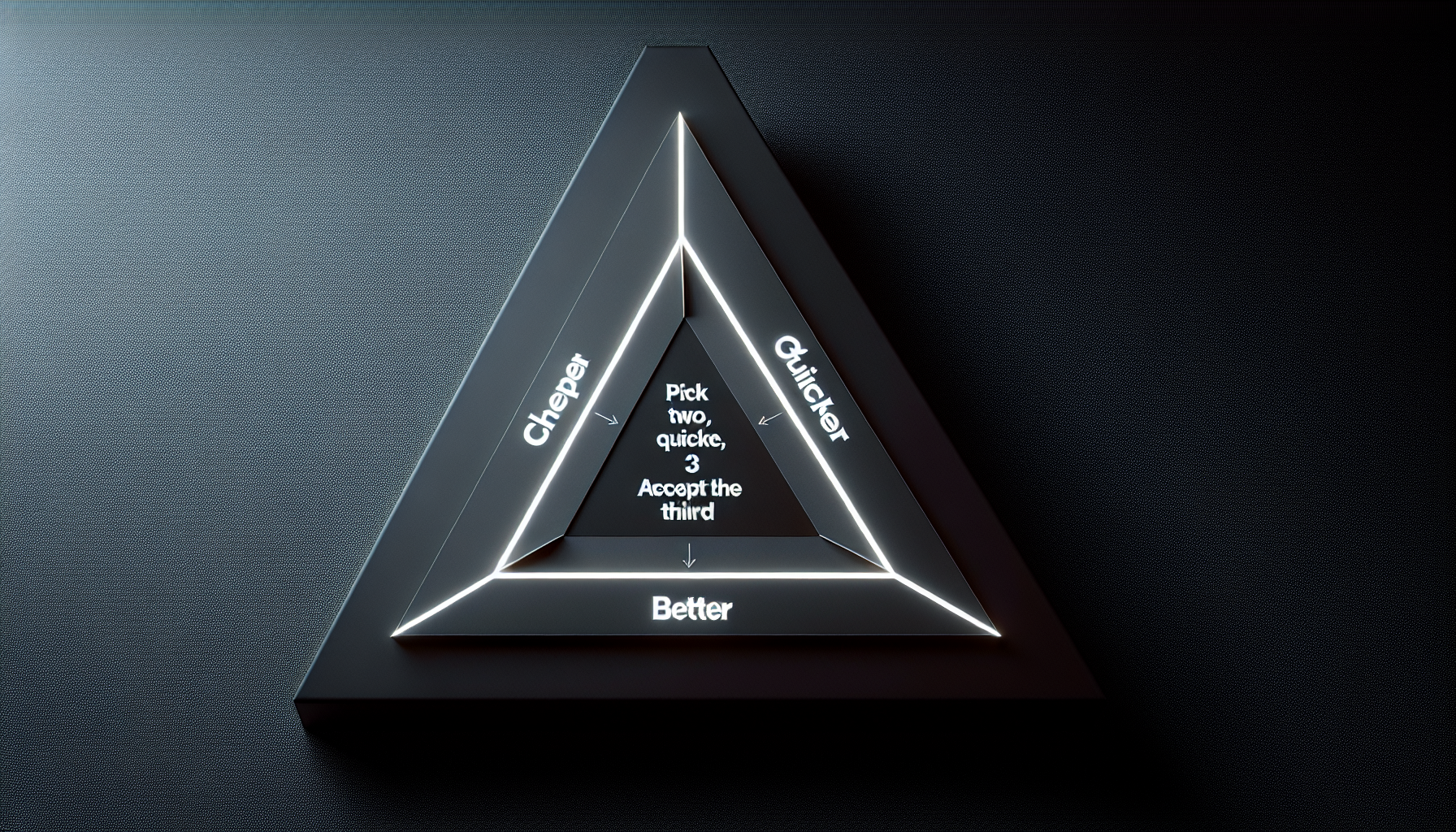
Every decision you make is a negotiation with reality. We all want everything: fast results, low cost, and high quality. Here's the uncomfortable truth: you can't have all three.
The Three Levers framework isn't just a business aphorism. It's a universal law governing outcomes. Understanding and consciously applying it transforms how you approach problem-solving, negotiation, and strategy.
The Three Levers
At the heart of every undertaking are three competing forces:
💰 Cheaper (Cost/Resources) — The financial investment, human capital, or resource expenditure. It's about minimizing outlay. In a deal, it's the bottom line. In a project, it's your budget and team size.
⚡ Quicker (Time/Speed) — The elapsed time to completion, the speed of delivery, the urgency of the deadline. It's about rapid iteration and fast time-to-market.
💎 Better (Quality/Scope) — The standard of excellence, the robustness of the solution, the breadth of features, and the overall value delivered. It's about building something that truly solves the problem.

The Immutable Rule
You cannot simultaneously maximize all three. Try to make something Cheaper, Quicker, AND Better, and you'll hit a wall of impossibility or burnout.
The magic—and the challenge—lies in consciously deciding which two levers you will prioritize, and accepting the necessary compromise on the third.
Cheaper & Quicker, but Not Better
This is the realm of the Minimum Viable Product (MVP) done on a shoestring. You get something out fast and cheap, but it's likely buggy, lacks features, and will require significant rework later. Think of a startup rushing a basic app to market to validate an idea—functional, but far from polished.
Cheaper & Better, but Not Quicker
This is the meticulous, long-term approach. An open-source project built by volunteers over years, resulting in robust, high-quality software delivered with minimal financial cost, but at a glacial pace. It's cost-effective and high-quality, but takes its sweet time to mature.
Quicker & Better, but Not Cheaper
This is where significant investment comes in. Large enterprises launching critical features or products. Netflix building a high-performance, resilient streaming infrastructure quickly requires a massive engineering team and advanced tooling. The outcome is superior and fast, but the price tag is substantial.
Real-World Examples
💪 Weight Loss
- Fast + effective + expensive: GLP-1 drugs
- Slow + sustainable + free: Diet and exercise
💵 Investing
- Low fees + solid returns: Index funds
- Fast gains + high fees: Hedge funds
🎓 Learning
- Fast + structured + pricey: Bootcamp
- Free + deep + slow: Self-study
💼 Career
- Rapid promotion + high sacrifice: Fast-track roles
- Meaningful + lower pay: Mission-driven work
❤️ Relationships
- Easy + no depth: Many shallow connections
- Takes massive time & vulnerability: Few deep bonds
The Power of Conscious Prioritization
The true value of this framework isn't in bemoaning its limitations, but in embracing its clarity. By forcing yourself to make a conscious choice, you gain several advantages:
Clarity in Decision-Making — No more vague goals. You precisely define what success looks like given the constraints.
Effective Communication — You can articulate trade-offs clearly to stakeholders, managing expectations proactively.
Strategic Resource Allocation — You direct your limited time, money, and talent towards what truly matters for the current goal.
Reduced Frustration — Understanding the inherent trade-offs removes the illusion that you can have it all, leading to more realistic planning and less disappointment.
Choose Your Path Wisely
The Three Levers—Cheaper, Quicker, Better—are not obstacles to overcome, but fundamental forces to master. In the fast-paced, resource-constrained world of tech, the ability to identify critical priorities and make conscious trade-offs is a superpower.
Whether you're building a groundbreaking product, learning a new technology, or navigating a career move, ask yourself: Which two levers are most vital right now? Which one am I willing to compromise on?
Choose wisely, communicate clearly, and you'll find yourself building not just better products, but a more strategic and successful life.